Monday, June 30, 2008

Casus Belli

The new edition of The New Yorker features a piece by Seymour Hersh, reporting that the Bush administration has initiated large-scale covert operations within Iran aimed at destabilizing the regime, and that Congress has given him $400 million to do so. US Special Ops and the CIA have been encouraging Baluchi, Ahwazis, and Kurdish dissident groups within Iran to increase attacks targeting the government and the Revolutionary Guard.

There is very significant support for US actions against Iran on both sides of the isle on the Hill. While very few Americans are in favor of a military strike against Iran, the tone of the Democratic Primary and the vote to declare the Revolutionary Guard a terrorist group certainly indicate there is a strong anti-Iran movement within the Democratic Party. Obviously, the $400 million would not have been allocated without the support of Democratic leadership in the House and the Senate. However, despite this support, the White House has kept Congress largely out of the loop in regards to the Pentagon’s actions in Iran.

“I suspect there’s something going on, but I don’t know what to believe. Cheney has always wanted to go after Iran, and if he had more time he’d find a way to do it. We still don’t get enough information from the agencies, and I have very little confidence that they give us information on the edge.” – Congressman David Obey, House Appropriations Committee Chair

Congress is not the only ones being kept out of the loop. Admiral William Fallon, David Petreus’s predecessor as head of CENTCOM, resigned due to disagreements with the White House over America’s Iran policy. Specifically, he ran into opposition from the Vice President’s office while trying to rein in Special Ops forces operating within his theater but not under his control.

These covert operations have been ongoing for at least the past six months, without a significant heightening of tensions between the United States and Iran. However, recent events involving Israel are worrisome. In May, Israel conducted a large practice operation in the Mediterranean involving over 100 planes, coincidentally the same distance west that Iran is east. Shabtai Shavit, a former head of Mossad, has said that Israel has “about a year” to destroy Iran’s uranium enrichment industry. Former Ambassador John Bolton theorized that Israel may attack late this year, after the presidential election but before Obama or McCain take office. The goal of these attacks would be to cripple Iran’s Uranium-enrichment industry. Israel has launched similar strikes in the past, in 1988 against Iraq and last fall against Syria. However, without American assistance it is highly doubtful that such an attack would be successful against Iran, due to its size and mountainous terrain.
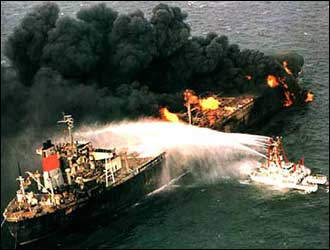
Worse, Iran has indicated that it will respond to any Israeli attack by closing the Strait of Hormuz, the thirty-five mile wide shipping lane into the Persian Gulf through which 40% of the world’s oil is shipped. A combination of mines artillery, and rockets could largely shut down the strait to commercial shipping. US Naval officials have said that the United States will not allow Iran to close off the Persian Gulf, and that any attempt to do so would be viewed as an act of war.
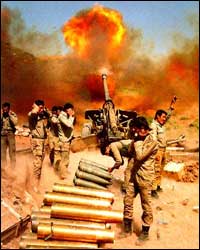
Here is the problem for the United States. It is very difficult to stop artillery and rockets coming out of unfriendly territory. Iran does not have to stop every oil tanker to hurt the US. Even the potential of a threat has driven the price of oil up. Imagine if an actual threat materializes. And due to the relative shallowness of the strait, every ship Iran sinks is a potential obstacle, making the shipping lanes even more dangerous. Case-in-point; the Israelis have been unable to stop rocket and mortar attacks coming out of Gaza, a 5 mile wide strip that they know like the back of their hand. How does the US stop similar attacks coming out of a much bigger territory in Iran without invading?

Gaza Strip drawn to Scale with Strait

Putting boots on the ground in Iran is the last thing the US wants to do. Remember, these guys trained Hezbollah. They are not going to line up for us in nice tank battles the way Saddam did. We don't really have a major opposition group to back like we did with the Northern Alliance in Afghanistan. We cannot cannot successfully wage a limited war with Iran.

Hopefully, cooler heads will prevail. A top aid to supreme leader Ayatollah Ali Khamenei came out in favor of negotiations, and cautioned against top Iranian officials using "provocative and illogical declarations and slogans," a reference to Iranian president Mahmoud Ahmadinejad's frequent predictions of the destruction of Israel. Recent developments in North Korea have shown that negotiations, combined with economic sanctions, can yield positive returns.

The United States has to be very careful with this issue. We have to hold Israel on a tight leash in regards to Iran. According to Shavit, getting American approval is "not a precondition" for an attack. This is bull. While Israel's fears of an Iranian nuclear program are justified, there are better ways of dealing with it than a preemptive strike that is unlikely to do more than delay weapons production. While we are doing as much to support Israel as we do, and when we will likely be the recipients of Iranian reprisals, they had damn well better wait for America to sign off on any attack.

The American congress should hold still-President Bush to a tighter leash as well. Both Barak Obama and John McCain promise to end the shoot-from-the-hip policies and byzantine power struggles that characterized the past eight years of American foreign policy. It would be a shame if, in his last days in office, Bush led us into a disaster like this.

Wednesday, June 18, 2008

How to be a Cartoonishly Evil Corporation; KBR in Iraq

It is often brought up by members of the Left that we went into Iraq because Mr. Cheney wanted to help his friends in Haliburton steal all the Muslims' oil. This would sound more like shrieking paranoia were it not for the good people over at KBR. Formally a Haliburton subsidiary called Kellogg Brown and Root, KBR has for the past five years been doing its best to act like a corporation in a Grisham novel. It is amazing how little press some of this stuff has gotten.

So KBR is currently the primary vendor of food and other supplies to American soldiers. It has been
paid $24 billion dollars since the war began, largely from no-bid contracts. It has been alleged that these contracts were given due to the company's political connections to the White House, via Dick Cheney. But what's a government sponsored monopoly between friends? If that were all, KBR would be barely more evil than Juan Trippe's PanAm in The Aviator.

Now there are plenty of stories coming out of Iraq highlighting the sort of shadyness and incompetence that KBR regularly displays. KBR found a great way to save money, for example, by
taking waste water, pouring some chlorine into it, filtering it, and piping it back to American Soldiers for bathing and laundry use. KBR is also under investigation for ignoring the warnings of its electricians about shoddy wiring, which may have led to the electrocution and death of 12 service members in Iraq. But where KBR really goes into Grisham territory is the story of Jamie Leigh Jones.

Jones was an employee of KBR in Iraq in 2006. She was roofied and raped by one of her fellow employees.
This in itself is not too uncommon for female contractors in Iraq. What made Jones's case special was her employers reaction to the news. You see, one might expect that when a company is presented with a terrible situation like this, they would quickly move to assist and console the victim. If for no other reason than to limit their financial liability. KBR decided to go a different route.

After Ms. Jones saw a US Army physician and was given a rape kit, which
confirmed that she had been drugged and raped by multiple parties, she was promptly escorted by KBR security to a shipping container. There she was held against her will for four days, until she managed to beg a cell phone from one of her guards. She called her father, who contacted Congressman Ted Poe. Poe contacted the State Department, which sent two Foreign Service Officers to rescue Ms. Jones.

Just like any Grisham-esq corporate thriller, the behavior of KBR makes very little sense. Why lock the poor girl up? At that point, why not kill her? I mean, if your banking on the "Iraq is the Wild West and therefor laws don't apply" theory, why not take it to its logical conclusion? Jones was not just raped. She ended up needing reconstructive surgery after the incident. It seems a bit unrealistic to expect her to cool her heels and get over it.

Of course Iraq is the Wild West, according to the Bush Administration, and KBR is a protected company. So the the Justice Department is in no rush to investigate and even though Ms. Jones returned form Iraq two years ago there has been little progress on her case. Her best hope for justice is to wait until January when the new administration comes in.

KBR's protection by the Bush administration has been reemphasized this week by new allegations against them, this time by
an ex-US army official who says he was fired for contesting "$1 billion in questionable payments".

"The official, Charles Smith, was the senior civilian overseeing the multibillion-dollar contract with KBR during the first two years of the war. Speaking out for the first time, Smith said that he was forced from his position in 2004 after informing KBR officials that the army would impose escalating financial penalties if they failed to improve their chaotic Iraqi operations. Army auditors had determined that KBR lacked credible data or records for more than $1 billion in spending, so Smith refused to sign off on the payments to the company.

'They had a gigantic amount of costs they couldn't justify,' he said. 'Ultimately, the money that was going to KBR was money being taken away from the troops, and I wasn't going to do that.'"

Smith was replaced by an outside contractor, who immediately authorized the payments.


In other news, KBR is opening up a new division dedicated to growing out handlebar mustaches and tieing damsels to railroad tracks. This is following revelations that KBR will soon begin feeding America's troops in Iraq a balanced diet of clubbed baby seal and recycled orphans.

Saturday, June 14, 2008

Muqtada Rebrands, and the "Status of Forces" agreement

This weekend saw two important events happen in Iraq, both of which make me optimistic about the political future of that country.

Firstly, PM Maliki has announced that the negotiations between Iraq and the United States for a new security agreement have reached an impasse. The Bush Administration has been promoting an agreement that would give American military personnel and contractors legal immunity from Iraqi courts, authority to conduct military operations without consulting the Iraqi government, control of Iraq's airspace and borders, and over 50 bases. The Iraqi's, conversely, are looking for an American guarantee to defend Iraq's borders from foreign invasion.

Many of these provisions are deeply unpopular in Iraq. Ayatollah Sistani has vocally opposed the deal, and had Maliki conceded to it he would have confirmed his critics accusations that he is merely an American puppet. The Bush administration has said that it "remains confident" that a deal will be reached by the end of July. Though this may be an optimistic estimate, some sort of deal will certainly be reached before the UN mandate for American forces runs out in December.

Secondly, Muqtada al-Sadr has announced that he is restructuring the Mahdi Army. The Mahdi army is already the largest distributor of humanitarian aid in Iraq. Much of the Mahdi rank-and-file will be turned into a civilian organisation focused on "religious, social and cultural affairs", increasing the organization's political strength. Meanwhile a smaller and more secretive group would continue attacks on, Coalition forces. "The weapons will be held exclusively by this new group, and they should be pointed exclusively at the occupier." Likely, the "new group" will be primarily made up of the Iranian trained Special Groups that have been so effective against both American and Iraqi forces. "We will not stop resisting the occupation until liberation or martyrdom," Sadr has said.

It may seem odd that these two events are signs of progress. Why is it good that the Iraqi government is repudiating the United States, and that a prominent politician is pledging to continue to kill American soldiers? Because both events hint that there will not be a cataclysmic civil war when we leave.


Both of the above mentioned events are proof of growing nationalism within Iraq, and a growing faith in the ability of the government to maintain stability. Maliki would not have stood up to the Bush administration over the Status of Forces agreement if he believed that the only thing holding him in power was American military might. And Sadr would not begin to demilitarize his militia at all if he did not see a route to power though democracy, or if he predicted a full scale civil war would break out soon. His only incentive to transform the Mahdi army into a civilian force is to expand his influence amongst the moderate Shiites.


Iraq is going to be messy. There are too many factions within the country that have an interest in a weak central government. Not just the Mahdi Army, but also the Sunnis and the Kurds, and above all the Iranians. But the Iraqi army is becoming increasingly capable of putting up a fight to the militia groups, and the country is unlikely to completely splinter apart the minute we leave.

Here are the facts; there is a finite amount of time that America can expect to maintain the current level of soldiers on active duty in Iraq and Afghanistan. Withdrawing from Iraq would would allow the American military to refocus its efforts on Afghanistan. Recent events there have certainly emphasized the need for more American boots on the ground in Kandahar and the rest of eastern Afghanistan.


The United States needs to drastically reduce its presence in Iraq, and soon. John McCain often says on the campaign trail that we should not leave Iraq until we have achieved "victory." But what does Victory entail? The vision of a Switzerland on the Euphrates just aint gona happen. A more realistic model may be India. India is also subjected to ethnic tensions and regular terrorism, but none the less has maintained a vibrant democracy. Perhaps if the United States began to move towards the door, we would be able to largely appease the Sadrists while still assisting the government.

What should be kept in mind, by both Mr. Bush in the waning days of his presidency and by both presidential candidates, is that their chief duty in Iraq is the stewardship of American power. Every action taken in Iraq by the United States must keep this in mind. When the NeoCons said that the post 9/11 world is a new and dangerous place for a superpower, they were not wrong. America cannot afford to dictate the next eight years of its foreign policy based on the "we broke it we bought it" theory.

What really is preventing us from declaring Victory? I am not talking about a gaudy speech on an aircraft carrier, but instead Bush and Petreus (or McCain and Petreus or Obama and Petreus) announcing that they believe that Iraqi can stand up on its own, and that America will withdraw, not as a defeated occupier, but as a friend and ally of the Iraqi people.

Thursday, June 12, 2008

Chuck Hagel at the Cato Institute...

I traveled to the Fun Loving Cato Institute today, for a free sandwich.

Oh, and Chuck Hagel was speaking there too.

Senator Hagel was speaking at the Cato institute today with two goals in mind: Hawk his book, and give a "I am running to be Obama's VP, but don't tell anybody" speech. He all but endorsed Obama, saying that he thought that America needed a "Thoughtful" presidency and then advocating most of Obama's signature foreign policys (on Iraq, Iran, etc...). When asked by the President of the Cato Institute whether he would accept an offer of the #2 spot on a presidential ticket from either of the candidates, Hagel coyly remarked that every politician would have to at least consider the offer of the vice presidency, though the Vice Presidential candidate for the Republicans should not have the sort of policy disagreements with McCain that he has.

I had not had an opportunity to see Hagel speak before this, and he certainly impressed me as a thoughtful and wise politician. I do not know how seriously the Obama campaign is looking across the isle for a VP, but they could do a lot worse than the senator from Nebraska. The man perspires sincerity, with a kind of exasperated, "lets cut the BS and get to work" vibe.
Sure, he is out of line with the Dems on a bunch of social issues, and Sure he would present a host of succession problems for year 7-8 of an Obama administration if he goes for the top seat as a Republican. And I know that he is not one of those swing-state guys that people like to attach to tickets.

Obama-Hagel lends credence to Barak's "New Politics" message of getting beyond the Clinton-Bush partisanship, and will certainly pull across a couple wavering elephants with him. This will be especially important in those Great Plains states that usually go Red but that Obama dominated in the Primaries. He will need those states too, because I just don't see Obama winning in a 51% election. If it comes down to Ohio-Penn-Florida, McCain is the next president.
Obama's 50 state strategy is the only strategy that could work for him, because if he does not get large defections from the neglected branches of the Republican party I don't think he can win. On the other hand, one of the oddest things about the speech at Cato was how the crowd seemed to want him to throw his hat in with Obama formally, so they could have an excuse to Punish the Republican party. The President of the Cato Institute straight up said that he might go with Obama if Hagel was his running mate. This is an institute named after a guy who was almost a caricature of conservatism!
(Full Disclosure, the above point is not true, as I recently found out. The institute was named after a couple of 17th century British libertarians who wrote under the alias Cato, not the Cato of Rome. But my point still stands.)

I expect that if Obama wins in November, it will be because he is running a much better campaign than McCain is, not because of his VP choice. But Hagel should still be brought in. He is leaving the Senate this November, and a man as sensible as he appears to be should not be allowed to waste in retirement.

Tuesday, June 10, 2008

Memo to Obama: Keep Gates

Richard Armitage and Michèle A. Flournoy have recently brought up that after the election there will be a time when many of the high level national security positions will be unfilled while the new administration's recommendations get confirmed by Congress. This leaves the United States unacceptably vulnerable, given that "2009 may well be the most precarious period in recent American history." Armitage and Flournoy bring up a number of sensible solutions to this problem, but there is an obvious one they missed: hold on to some people, specifically Robert Gates.

Now, I am all for the "throw the bastards out" philosophy; the ability to remove demonstratively failing leadership is the best argument for democracy. But many of the catastrophes that Gates currently presiding over were not of his creation. Given the state of the wars in Iraq and Afghanistan when Rumsfield stepped down, I believe that Gates has performed admirably.

There have been a number of columns recently praising Robert Gates for his decision to sack General Mike Moseley and replace him with General Norton Schwartz. Schwartz is notable for not being a fighter pilot. The Air Force has been dominated by fighter pilots for quite some time, and this is reflected in their procurement priorities (cough cough F22 cough). Schwartz's elevation will hopefully bring some reason to the Air Force's priorities.

He has advocated negotiations with Iran, to the chagrin of the Bush administration. Together with General Petraeus, Gates has made an effort to get the military to actually focus on the two wars it is currently waging, rather than continually preparing to go twelve rounds with the Russia or China.
I believe that Obama would see the most benefit from holding on to Robert Gates. If he wins in November, it will be largely attributed to his message of "a new kind of politics." What better way to visibly deviate from the fierce partisanship that has characterized the past 16 years than to keep a high ranking Republican cabinet member? Also, it would send a signal to America's enemies that, though Obama may be less bellicose that Bush, he ain't no pushover. McCain might not want to retain any Bushies for the purely political reason of not wanting to appear to be W's third term. But Obama should strongly consider Gates' s retention as a good first act of his presidency.


Monday, June 9, 2008

Speculation on the Future of the Mahdi Army

David Ignatious has written an excellent piece on Brig. Gen. Qassem Soleimani, the head of the Iranian Quds Force. It’s a quick read and has some good insights in it.

The Quds Force is like a Persian hybrid of the French Foreign Legion and the Dulles-era CIA. While organizationally its placed within the Revolutionary Guard, it has often been reported that Soleimani reports directly to Supreme Leader Ayatollah Khamenei. The Mission Statement of the Quds Force is the export of Islamic Revolution, and to meet this goal it trains and supplies terrorist groups around the globe. Hezbollah is a Quds Force darling, as was the Northern Alliance against the Taliban back when America's only interest in Afghanistan was bemoaning exploded Buddahs. The US State Department has labeled the Quds Force a "Terrorist Organization", which is technically accurate but besides the point. First and foremost, the Quds Force works for Iranian interests.

Nowhere is this cleared than in Iraq. Ideologically, Muqtada al-Sadr is Iran's most natural ally. He is wants to establish a Shia Islamic state in Iran, and is no great fan of America. There is only one problem; the guy is a legitimate Iraqi nationalist. Unlike the Badr Brigade and the SIIC (Supreme Islamic Iraqi Council, the dominant mainstream Shia party), Sadr and his family sweated out the Saddam era in Baghdad. So while he is very willing to take those nice Iranian-made RPG's and shaped charges thankyouverymuch, he is much less comfortable taking his marching orders from a Persian sugar-daddy. The Badr Brigade and a large number of "moderate" Shia politicians make no such claim.
The alliance between Sadr and Iran is a marriage of convenience. Iran supplies the Madhi Army, and Sadr keeps America on its toes. So here is the question; what happens when it looks like the US is really out the door? This brings me back to
Soleimani.

Iran would certainly prefer a nice pliable SIIC government next door than a demonstrated hardcase like Sadr. Currently, Iran supplies both sides of the Shia-Iraqi bloodfeud, largely to keep things fun for Coalition forces. So if Obama or McCain gets in and starts making serious motions towards getting out of dodge, what is Iran's response?

There are two ways of looking at this; either Iran wants the US stuck in Iraq, or it just wants America out of the neighborhood. Personally, I subscribe to Gary Brecher's theory that the US military would get seriously bloodied if we tried to take on Iran while we were in Iraq, due to the vulnerability of our ships in the Gulf and Iran's demonstrated ability to manage Iraqi insurgent groups. Keeping the US in Iraq allows Iran to score points off us largely free from retribution. But the Iranians may just figure that the past five years of war have worn out the American electorate's appetite for conflict, and having a large American presance next door is more likely to do harm than good. In that case, Soleimani may try to keep a lid on the Mahdi Army and the Badr Brigade as much as possible, so the US feels it is safe to leave.

Ok, so now here is the scenario. America has largely pulled out of the country, leaving behind a couple of "military advisers", pilots flying from Iraqi bases, and probably a handful of special-ops. The Iraqi army is still just the Badr Brigade dressed up in a different uniform. Sadr is probably the most popular Shia politician in Iraq, because he can claim that he is the only major player to have fought both Saddam and the Americans. But right there his advantages end. Sadr's best troops are the Quds-trained "Special Groups", but I wonder whether their loyalties lie more with Muqtada, or with their suppliers in Iran. Sadr will no longer be able to polish his rep by fighting and denouncing coalition forces.

At that point, whats to keep Soleimani from deciding that Iran can better retain influence in Iraq without the obstinate, nationalistic Sadr? Nobody wants to have chaos on their borders. So Sadr sees his supply lines from Iran largely dry up, and his best troops no longer heeding his call. At this point, Sadr's options become very limited. Once you look past his glower, theatrics, and penchant for impersonating Darth Vader on magazine covers, Sadr looks a lot like a guy who is riding a political movement rather than a guy who can maintain one. He might try his luck with democracy, but reports coming out of areas controlled by the Mahdi Army don't seem to indicate the sort of local support that continues on once the occupier has gone home.

Of course, all this is dependent on the assumption that the Iranians don't chose to continue to support Sadr after America leaves. Unfortunately, guys like Soleimani don't often submit themselves to teary, tell-all interviews with Barbra Walters. But I just cannot see the Badr Brigades and the Mahdi Army coexisting for long, and I cannot see Iran backing a gamble like Sadr when a known quantity like the SIIC exists.

About Me

Washington, DC, United States
I am a wanabe Political Scientist (whatever that means) and novice travel writer. I am currently working in Taipei as an English teacher, while learning Chinese and looking for jobs back home. The blog's title no longer seems quite as appropriate as it did when I was working temp jobs in DC. But over time it's whineyness has grown on me, so your all stuck with it. Disclosure: Whenever I find out that I was mistaken about something I have written, or if I change my mind, I will go back and change what I had previously written. Lunatics yelling into the night sky rarely bother to print retractions. But the heavens are a less effective stenographer than the internet.