
There is very significant support for US actions against Iran on both sides of the isle on the Hill. While very few Americans are in favor of a military strike against Iran, the tone of the Democratic Primary and the vote to declare the Revolutionary Guard a terrorist group certainly indicate there is a strong anti-Iran movement within the Democratic Party. Obviously, the $400 million would not have been allocated without the support of Democratic leadership in the House and the Senate. However, despite this support, the White House has kept Congress largely out of the loop in regards to the Pentagon’s actions in Iran.
“I suspect there’s something going on, but I don’t know what to believe. Cheney has always wanted to go after Iran, and if he had more time he’d find a way to do it. We still don’t get enough information from the agencies, and I have very little confidence that they give us information on the edge.” – Congressman David Obey, House Appropriations Committee Chair
Congress is not the only ones being kept out of the loop. Admiral William Fallon, David Petreus’s predecessor as head of CENTCOM, resigned due to disagreements with the White House over America’s Iran policy. Specifically, he ran into opposition from the Vice President’s office while trying to rein in Special Ops forces operating within his theater but not under his control.
 These covert operations have been ongoing for at least the past six months, without a significant heightening of tensions between the United States and Iran. However, recent events involving Israel are worrisome. In May, Israel conducted a large practice operation in the Mediterranean involving over 100 planes, coincidentally the same distance west that Iran is east. Shabtai Shavit, a former head of Mossad, has said that Israel has “about a year” to destroy Iran’s uranium enrichment industry. Former Ambassador John Bolton theorized that Israel may attack late this year, after the presidential election but before Obama or McCain take office. The goal of these attacks would be to cripple Iran’s Uranium-enrichment industry. Israel has launched similar strikes in the past, in 1988 against Iraq and last fall against Syria. However, without American assistance it is highly doubtful that such an attack would be successful against Iran, due to its size and mountainous terrain.
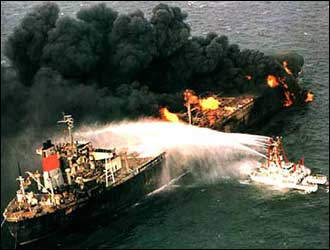 Worse, Iran has indicated that it will respond to any Israeli attack by closing the Strait of Hormuz, the thirty-five mile wide shipping lane into the Persian Gulf through which 40% of the world’s oil is shipped. A combination of mines artillery, and rockets could largely shut down the strait to commercial shipping. US Naval officials have said that the United States will not allow Iran to close off the Persian Gulf, and that any attempt to do so would be viewed as an act of war.
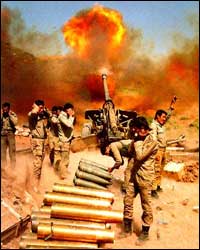 Here is the problem for the United States. It is very difficult to stop artillery and rockets coming out of unfriendly territory. Iran does not have to stop every oil tanker to hurt the US. Even the potential of a threat has driven the price of oil up. Imagine if an actual threat materializes. And due to the relative shallowness of the strait, every ship Iran sinks is a potential obstacle, making the shipping lanes even more dangerous. Case-in-point; the Israelis have been unable to stop rocket and mortar attacks coming out of Gaza, a 5 mile wide strip that they know like the back of their hand. How does the US stop similar attacks coming out of a much bigger territory in Iran without invading?
 Gaza Strip drawn to Scale with Strait
Hopefully, cooler heads will prevail. A top aid to supreme leader Ayatollah Ali Khamenei came out in favor of negotiations, and cautioned against top Iranian officials using "provocative and illogical declarations and slogans," a reference to Iranian president Mahmoud Ahmadinejad's frequent predictions of the destruction of Israel. Recent developments in North Korea have shown that negotiations, combined with economic sanctions, can yield positive returns.
 The United States has to be very careful with this issue. We have to hold Israel on a tight leash in regards to Iran. According to Shavit, getting American approval is "not a precondition" for an attack. This is bull. While Israel's fears of an Iranian nuclear program are justified, there are better ways of dealing with it than a preemptive strike that is unlikely to do more than delay weapons production. While we are doing as much to support Israel as we do, and when we will likely be the recipients of Iranian reprisals, they had damn well better wait for America to sign off on any attack.
The American congress should hold still-President Bush to a tighter leash as well. Both Barak Obama and John McCain promise to end the shoot-from-the-hip policies and byzantine power struggles that characterized the past eight years of American foreign policy. It would be a shame if, in his last days in office, Bush led us into a disaster like this.

1 comment:
I can't see the closure of straight as something the rest of the world would tolerate. A lot of countries enjoy that refreshing light sweet crude.
Post a Comment